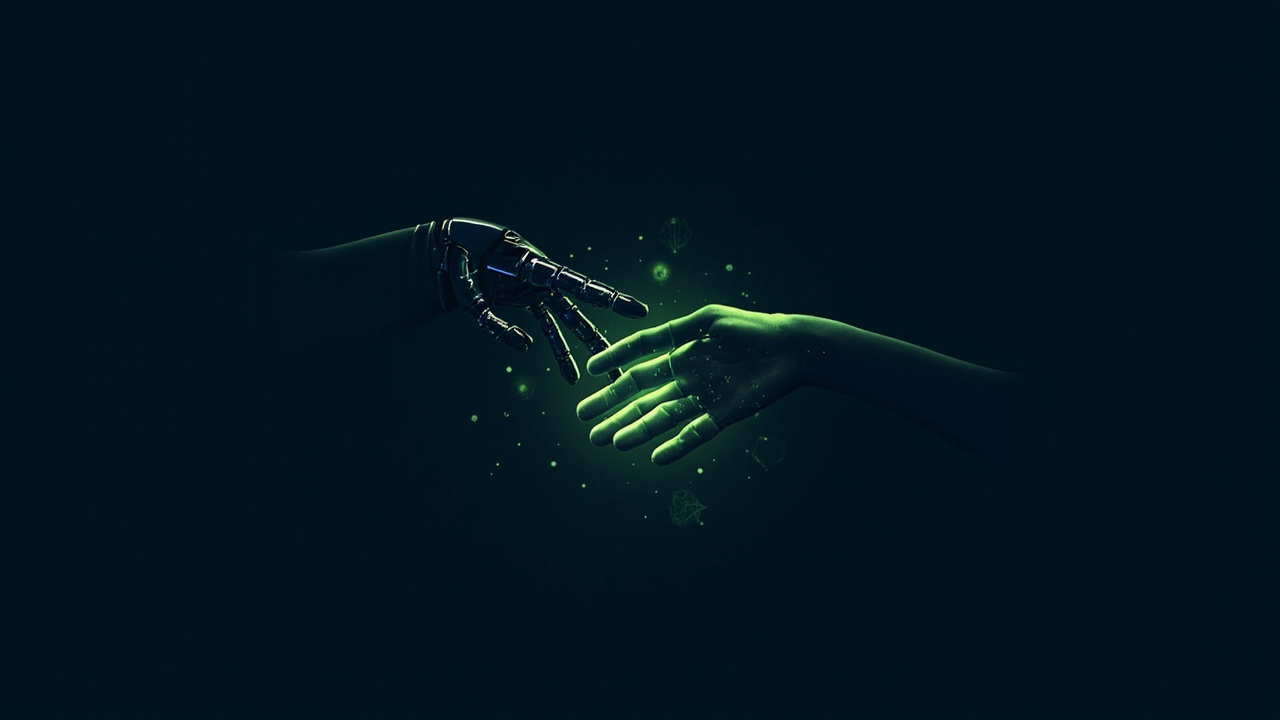
For years, AI has been nothing more than a sophisticated toolbox — powerful, efficient, but ultimately passive. Ask a question, get an answer. Give a command, get a result. It waited. It processed. It never truly *understood* you.
That era is ending.
AI Is Growing Up: From Toolbox to Partner
The shift happening right now is deeper than it looks on the surface. AI isn't just getting smarter — it's changing its fundamental relationship with humans. Three big movements are driving this:
The result? AI is evolving from "tool" to "partner" — and that changes everything.
Foundation Models Are Rewiring Themselves
The old playbook for building capable AI was simple: more data, bigger model, better results. That logic is breaking down. The new frontier isn't scale — it's self-optimization.
Reinforcement learning is leading this charge. Rather than learning from human feedback (RLHF), models are increasingly learning from verifiable outcomes — correct code compilations, mathematically proven solutions, tasks that can be objectively scored. When a model gets it right, it knows *why* it got it right. When it fails, it knows exactly what went wrong.
This is a fundamentally different kind of intelligence. It's not pattern matching against human taste. It's discovering strategies that work — even strategies humans never considered.
The second major shift is native multimodal architecture. Early multimodal AI was a frankenstein — bolt a vision model onto a language model and call it integrated. Native multimodal models are different: they treat text, image, audio, and video as a unified input space from the ground up. Perception and generation happen in the same framework.
The implications are massive. A model that sees a video, hears the tone of voice, and reads the underlying intent simultaneously — and synthesizes all of that into a coherent response — is a fundamentally different artifact than a system that processes modalities in silos.
And then there's voice. Voice models have crossed a threshold. They no longer "read aloud." They understand emotion, nuance, and context in real time. The conversational experience is becoming genuinely warm. This breaks down language barriers not just linguistically but emotionally — AI can now communicate across cultures in ways that feel human.
The Agent Revolution Is Here
If foundation models are the brain, agents are the hands. And the agent landscape is splitting into two distinct schools.
Orchestration-based agents use LLMs as central decision-makers, orchestrating tools and APIs through predefined code paths. Think AutoGPT, LangChain flows — powerful for structured tasks where you can plan ahead.
End-to-end agent models take a different approach entirely. Instead of external orchestration, they train reasoning, planning, and tool-use *directly into the model weights*. The model dynamically directs its own execution. OpenAI's o-series and Deep Research are early examples of this school.
Both approaches will coexist. They're not competing — they're optimized for different use cases.
What agents are already doing in the wild:
- Scheduling and task coordination — agents that manage your calendar, filter emails, handle cross-platform operations
- Digital employees — AI "workers" with defined roles, boundaries, and accountability, deployed into business processes
- LifeOS — the idea that AI should be a lifelong companion that understands your habits, anticipates your needs, and acts proactively rather than reactively
AI Is Leaving the Screen
Everything we've discussed so far lives in the digital realm. But the most profound shift is AI moving into physical space.
Spatial intelligence is the breakthrough. Instead of processing tokens (text chunks), AI is learning to understand voxels — three-dimensional space units. This means AI can perceive, reason about, interact with, and generate 3D environments. It's the difference between reading a blueprint and *understanding a building*.
This is reshaping:
- Autonomous vehicles — understanding the full 3D world around a car in real time
- Robotics — robots that can navigate and operate in human environments, not just controlled factory floors
- Mixed reality — AI that understands the physical space it inhabits and augments it intelligently
- Surgery and medicine — AI-assisted procedures with spatial awareness
Closely related is embodied intelligence — AI integrated with physical hardware (robots, wearables, autonomous systems) that can *perceive and act* in the real world. This is the "GPT-2 moment" for robotics: the technology is mature enough that the next leap is application and scale, not fundamental research.
Governments are noticing. Intelligent robotics has been classified as strategic infrastructure in several major economies. The industrialization of embodied AI — robots moving from labs to mass production — is no longer a research question. It's a business and policy question.
What This Means for Builders
If you're building with AI, these trends have concrete implications:
Agents are your new architecture unit. Stop thinking about AI as an API you call. Think about AI as a worker you deploy, monitor, and manage. The workflow design question becomes: what does the agent do, what does the human do, and how do they communicate?
Multimodal is table stakes. If your application only handles text, you're behind. The competitive edge is in understanding and generating across modalities — especially voice and spatial data.
The physical world is the new frontier. Digital-first AI is mature. The greenfield is physical: robotics, autonomous systems, spatial computing. If you're not thinking about this, someone else is.
Foundation model capability is still the moat. Everything else — agents, multimodality, embodied systems — builds on foundation model quality. Investing in understanding and evaluating foundation models is still the highest-leverage activity in the space.
The Relationship Is Changing
The deepest implication is one that gets lost in technical discussions: the human-AI relationship is fundamentally changing.
AI used to be a utility. You turned it on, used it, turned it off. Now it's becoming a presence — something that knows you, grows with you, and operates alongside you in the world.
That comes with real questions. How much do we trust AI with our daily lives? What does accountability look like when an agent acts on your behalf? How do we maintain human agency in a world where AI is increasingly making decisions for us?
These aren't theoretical. They're design questions, policy questions, and product questions — and they're being answered right now.
The toolbox era is over. What comes next is on us to shape.
Credit
- Original report: Tencent Research Institute — *Symbiotic Partners: 2025 AI Top 10 Trends*
- Original author: Si Xiao (Tencent VP & Director of Research Institute)
- Rewritten by: Lugon (TeguFy)